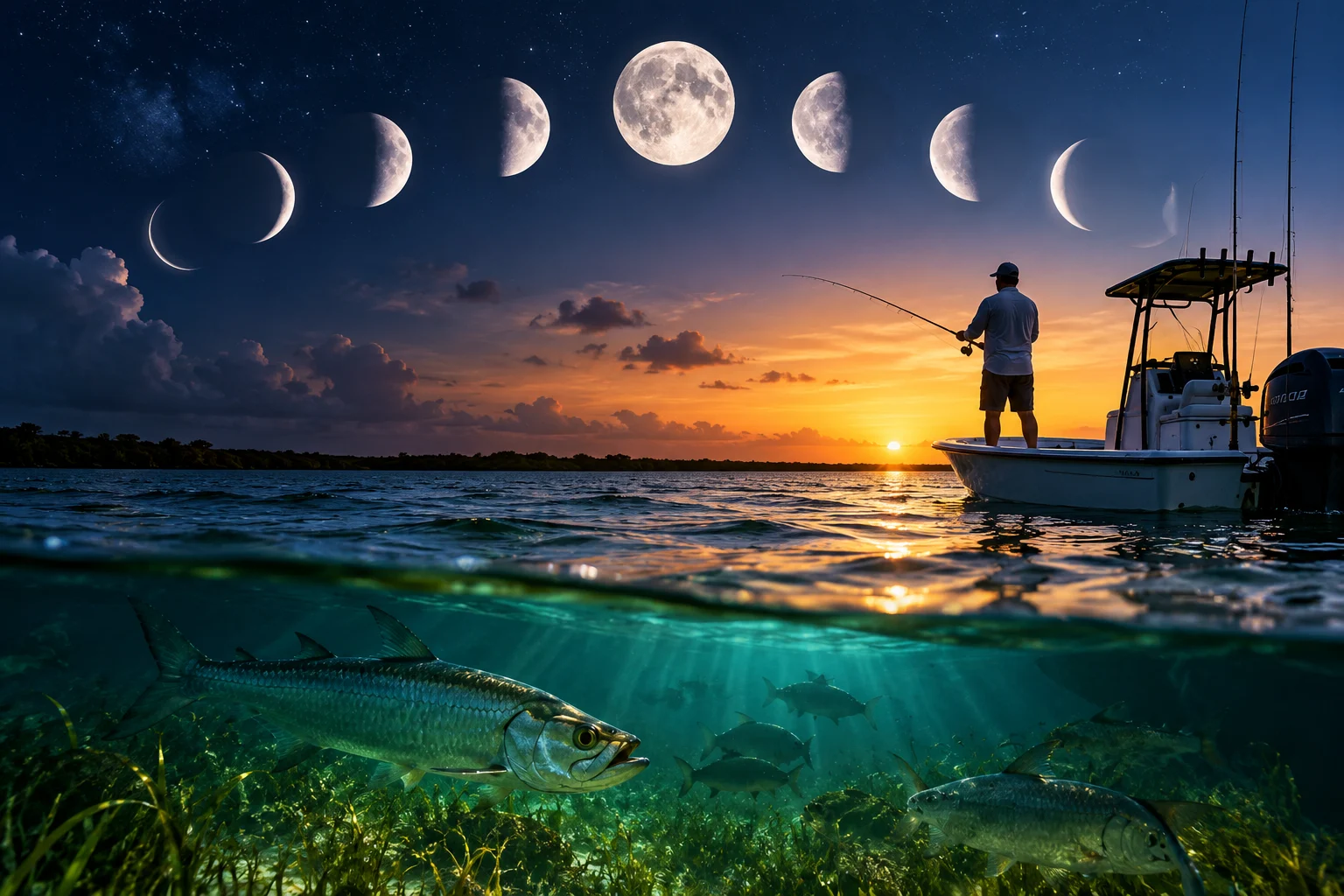
If you spend enough time around anglers, you will eventually hear someone talk about the moon. Some fishermen swear that a full moon brings better fishing. Others prefer a new moon. Some plan their trips around solunar charts, while others pay little attention to the lunar calendar.
So, does moon phase affect fishing?
Yes, the moon can influence fishing conditions, but it is not a guarantee that you will catch more fish. The moon affects tides, light levels, and the timing of some natural activity. These changes can influence where fish move and when they feed.
However, moon phase is only one part of the picture. Weather, water temperature, tides, current, bait activity, water clarity, time of day, location, and the species you are targeting can all have a major effect on your results.
The best way to use the moon is not to treat it as a magic fishing calendar. Instead, use it as one more piece of information when planning a trip.
Key Takeaways
- Moon phase can influence fishing, but it does not guarantee that fish will bite.
- Full and new moons create stronger tidal ranges, which can increase water movement and affect feeding patterns in coastal areas.
- Moonlight can influence nighttime fish activity, especially for species that feed or move after dark.
- The best moon phase depends on the species and location. Different fish can respond differently to lunar conditions.
- Tides, weather, water temperature, current, bait activity, and location can be just as important as the moon phase.
- Use moon phase as one part of your fishing plan, rather than relying on it as the only factor when choosing when to fish.
What Is Moon Phase?
The moon phase describes how much of the moon’s illuminated surface appears visible from Earth.
The main phases are:
- New moon
- Waxing crescent
- First quarter
- Waxing gibbous
- Full moon
- Waning gibbous
- Third quarter
- Waning crescent
The complete cycle takes about 29.5 days.
The amount of moonlight and the position of the moon relative to the Earth and Sun change throughout this cycle. These changes can influence natural conditions in both coastal and freshwater environments.
For fishermen, the most important connection is often between the moon and tides.
How Does the Moon Affect Tides?
The Moon’s gravitational pull is one of the main forces responsible for Earth’s tides. The Sun also contributes to tides, although the Moon has the larger influence because it is much closer to Earth.
When the Sun, Earth, and Moon are positioned so their gravitational effects reinforce each other, the difference between high and low tide becomes greater.
This happens around the new moon and full moon and produces what are called spring tides.
About a week after a new or full moon, the Sun and Moon are positioned at roughly right angles relative to Earth. Their tidal effects partially oppose each other, producing neap tides, which have a smaller tidal range.
This is important because moving water can influence feeding opportunities for many fish.
Why Do Tides Matter to Fishing?
The tide does more than simply make the water level rise and fall.
Tidal movement also creates currents.
As water moves, it can carry baitfish, shrimp, crabs, plankton, and other food sources. Predatory fish may position themselves in areas where moving water brings food within reach.
This is why experienced saltwater anglers often pay close attention to when the tide is moving, rather than simply looking at whether it is high or low.
NOAA notes that tides are accompanied by horizontal water movement called tidal currents, with flood currents occurring as the tide rises and ebb currents occurring as it falls.
For fishing, that movement can sometimes be more useful than the moon phase itself.
Is Fishing Better During a Full Moon?
A full moon can create interesting fishing conditions, but it does not automatically mean better fishing.
One reason anglers associate the full moon with good fishing is the combination of stronger spring tides and increased nighttime light.
Some fish and prey species are more active at night under brighter conditions. Other fish may behave differently because they can feed during the night rather than relying as heavily on daylight.
For anglers targeting certain species, this can change where fish are located or when they are actively feeding.
But a full moon can also make fishing more challenging.
If fish feed heavily overnight, they may be less active during the following morning. This is one reason some anglers prefer fishing during the night around a full moon rather than assuming sunrise will always be the best opportunity.
There is no universal rule that a full moon equals better fishing.
Is a New Moon Good for Fishing?
The new moon is another period that many anglers watch closely.
Unlike a full moon, a new moon produces very little visible moonlight at night.
New moons also occur during spring tides, meaning the tidal range can be relatively large.
For coastal anglers, the stronger tidal movement can create productive conditions in locations where current is important.
The darker nights may also change the behavior of certain fish and prey species.
Whether this improves fishing depends heavily on the species, location, tide, weather, and time of day.
Does a Full Moon Affect Freshwater Fishing?
It can, but the relationship is less straightforward than simply saying one moon phase is best.
Freshwater fish do not experience ocean tides in the same way coastal fish do. However, fish can respond to changes in nighttime light and lunar cycles.
Research on largemouth bass, for example, found that lunar phase was associated with changes in activity and depth distribution during many of the lunar cycles studied, although the patterns were not consistent throughout the year. The researchers also concluded that commonly used solunar tables had limited predictive value for identifying peak fishing times.
That is an important point.
The moon can influence fish behavior without providing a simple “fish will bite better on this date” rule.
Does Moonlight Make Fish More Active?
It can influence activity in some situations.
Moonlight changes how much natural light is available at night. This can affect both predator and prey species.
Some predators may find it easier to hunt under a brighter moon. Meanwhile, prey species may alter their behavior to avoid predators.
These changes can affect where fish are located and when they feed.
However, different species behave differently.
A predator that benefits from hunting in brighter conditions may respond differently from a species that prefers darker environments.
This is why moon phase should always be considered alongside the species you are targeting.
What Are Solunar Tables?
Solunar tables are fishing and hunting guides that use the positions and movements of the Sun and Moon to predict periods of potentially increased animal activity.
These tables commonly identify major and minor periods during the day when fish or wildlife are expected to be more active.
Many anglers use them when planning fishing trips.
However, they should be treated as a planning tool rather than a guarantee.
Scientific research has found that lunar effects on fish behavior can exist but are not always consistent. The largemouth bass study mentioned earlier found seasonal differences and did not support using solunar periods as a reliable standalone predictor of peak fishing.
Does the Moon Affect Saltwater Fishing More Than Freshwater Fishing?
Not necessarily.
The moon has a particularly obvious connection to saltwater fishing because it drives the astronomical forces behind tides.
Freshwater fish do not experience ocean tides in most lakes and rivers, so the mechanism is different.
In freshwater, changes in nighttime illumination and biological rhythms may be more relevant.
In coastal fishing, the moon’s influence on tides and currents can be extremely useful.
That does not mean saltwater fishing always improves during a certain moon phase.
Local conditions still matter.
Which Moon Phase Is Best for Fishing?
There is no single moon phase that is best for every fishing situation.
However, many anglers pay special attention to:
New moon: Strong tidal range combined with darker nights.
Full moon: Strong tidal range and bright nighttime conditions.
First quarter and third quarter: Generally associated with weaker tidal ranges compared with full and new moons.
NOAA confirms that new and full moons produce spring tides with larger tidal ranges, while first and third quarter phases are associated with neap tides and smaller tidal ranges.
Which one works best depends on your fishing location and target species.
Is a Rising Tide Better for Fishing?
A rising tide can be productive in many coastal environments because incoming water can push bait and other food sources toward shallow areas.
Fish may move into these areas to feed.
For example, shallow flats, grass beds, oyster areas, mangroves, points, and creek mouths can become more active as water rises.
But not every location fishes best on an incoming tide.
Some areas can produce better during an outgoing tide when water drains from shallow areas and carries bait toward deeper channels.
The important question is often not simply “high tide or low tide?”
Instead, ask:
Where is the water moving, and where will the fish position themselves because of that movement?
Is a Falling Tide Good for Fishing?
Absolutely.
An outgoing tide can concentrate bait and smaller organisms as water leaves shallow areas.
Predatory fish may position themselves near:
- Creek mouths
- Channels
- Points
- Cuts
- Bridges
- Oyster edges
- Passes
- Drop-offs
These areas can act like funnels.
Bait moving through a narrow opening becomes easier for predators to intercept.
This is one reason experienced anglers often look for areas where current is concentrated rather than simply fishing anywhere during a particular moon phase.
Does Moon Phase Affect Night Fishing?
Night fishing is one area where the moon can be especially noticeable.
A full moon provides considerably more natural light than a new moon.
This can change the behavior of fish and their prey.
Some species may feed more actively during brighter nights, while others may become more cautious.
Artificial lights can also become more important during darker moon phases.
Lighted docks, bridges, marinas, and other structures can attract small organisms and baitfish, which may then attract larger predators.
The result can be very different from one location to another.
Does the Moon Affect All Fish the Same Way?
No.
This is one of the most important things to remember.
Fish species have different feeding patterns, habitats, senses, and daily activity cycles.
A moon phase that seems productive for one species may not produce the same result for another.
Even fish of the same species can respond differently depending on water temperature, season, available food, spawning activity, and weather.
Research on fish catches has also found different relationships between lunar phases and different species. One study of marine fisheries in India found that catch patterns varied among species, with some showing increases during particular lunar periods and others showing different trends.
There is no universal moon-phase rule for every fish.
Does Moon Phase Affect Bass Fishing?
Bass anglers frequently discuss moon phases, particularly during spawning periods.
Lunar cycles may influence activity patterns, but water temperature, seasonal changes, weather, forage availability, and habitat are also important.
Research on largemouth bass found some relationships between lunar phase and fish activity and depth, but these relationships varied by season and were not consistent enough to make lunar phase a reliable standalone predictor.
So if you are bass fishing, use the moon as one piece of information rather than the deciding factor.
Does Moon Phase Affect Offshore Fishing?
Offshore anglers may consider lunar cycles when targeting species that respond to changes in feeding activity, currents, or spawning behavior.
The effect can vary significantly by species.
Tuna, billfish, snapper, grouper, and other offshore species do not necessarily respond to the moon in exactly the same way.
For offshore trips, weather, sea conditions, current, water temperature, bait concentration, and seasonal fish movement are often just as important.
What Matters More Than Moon Phase?
If you are trying to improve your fishing results, do not become so focused on the moon that you ignore other conditions.
Pay attention to:
Weather
Changes in wind, clouds, pressure, and storms can influence fishing conditions.
Water Temperature
Many fish species have preferred temperature ranges. Seasonal temperature changes can affect where fish move and how actively they feed.
Water Clarity
Clear and dirty water can produce very different fishing conditions.
Current
Current can concentrate bait and create feeding opportunities.
Bait Activity
Where the bait is located, predators are often nearby.
Time of Day
Sunrise and sunset can be important feeding periods for many species.
Location
A great moon phase does not help much if you are fishing an area where the fish are not present.
How Should You Use the Moon When Planning a Fishing Trip?
The best approach is to use the moon as part of a bigger plan.
Start by checking the moon phase.
Then check the local tide chart if you are fishing coastal waters.
After that, look at weather, wind, water temperature, and recent fishing reports if they are available.
Finally, consider the species you want to catch and the habitat where that species is likely to be found.
This approach is much more useful than simply checking whether the moon is full.
Remember that actual tide times and heights vary by location. NOAA points out that local geography, water depth, coastline shape, and other factors influence the timing and size of tides.
Should You Plan a Fishing Trip Around the Moon?
You can, but you should not plan the entire trip around it.
If the weather looks dangerous, a perfect moon phase will not make it a good fishing day.
If the tide is poor for your target species, the moon phase alone may not change that.
If fish are following a seasonal bait run, that may be much more important than whether the moon is full or new.
The moon is best used as another tool in your fishing planning process.
Frequently Asked Questions
Is fishing better before or after a full moon?
It depends on the species, location, tides, and conditions. Some anglers find the periods around a full moon productive, but there is no universal rule.
Does the moon affect fish feeding times?
It can. Changes in moonlight and lunar cycles may influence the timing and intensity of feeding for some species.
Is a new moon better for daytime fishing?
Not necessarily. A new moon can produce strong tidal ranges, but daytime fishing success still depends on factors such as weather, current, water temperature, and bait activity.
Does moonrise matter when fishing?
Moonrise can influence the amount of natural light available and is included in some solunar fishing predictions. Its importance varies by species and fishing environment.
Does moonset affect fishing?
It can be considered alongside other lunar and environmental factors, but moonset alone is not a reliable indicator that fish will start biting.
Should I use a moon calendar when planning a fishing trip?
A moon calendar can be useful for understanding lunar conditions. For coastal fishing, it is even more useful when combined with a local tide chart.
Does the moon affect fishing in rivers?
The effect can vary. Rivers generally do not experience ocean-style tides throughout their entire length, so water flow, rainfall, temperature, and river conditions may be more important.
Can a full moon make fish harder to catch?
It can in some situations. If certain fish feed more actively at night under bright moonlight, they may behave differently during the following daylight hours.
Does moon phase affect baitfish?
Lunar light and cycles can influence the behavior and movement of some baitfish and other aquatic organisms. This can indirectly affect predatory fish.
Is moon phase more important than weather for fishing?
Usually, you should consider both. Weather can dramatically change water conditions, visibility, wind, temperature, and fish behavior, so moon phase should not be viewed in isolation.
So, Does Moon Phase Affect Fishing?
Yes, but the effect is more complicated than many fishing myths suggest.
The Moon has a major influence on tides, and tides create water movement that can affect where bait and predatory fish are found. Full and new moons produce stronger tidal ranges, while the first and third quarter phases generally produce weaker tidal ranges.
Moonlight can also influence nighttime behavior, particularly for species that feed or move after dark.
But there is no moon phase that guarantees a great fishing trip.
The best anglers look at the whole picture. They consider the moon, tides, current, weather, water temperature, bait, season, location, and target species.
If you start keeping track of these conditions during your own trips, you may eventually notice patterns that are useful in your favorite fishing area.
The moon can help you choose when to go, but knowing where the fish should be and why they should be there is what can turn that information into a successful day on the water.